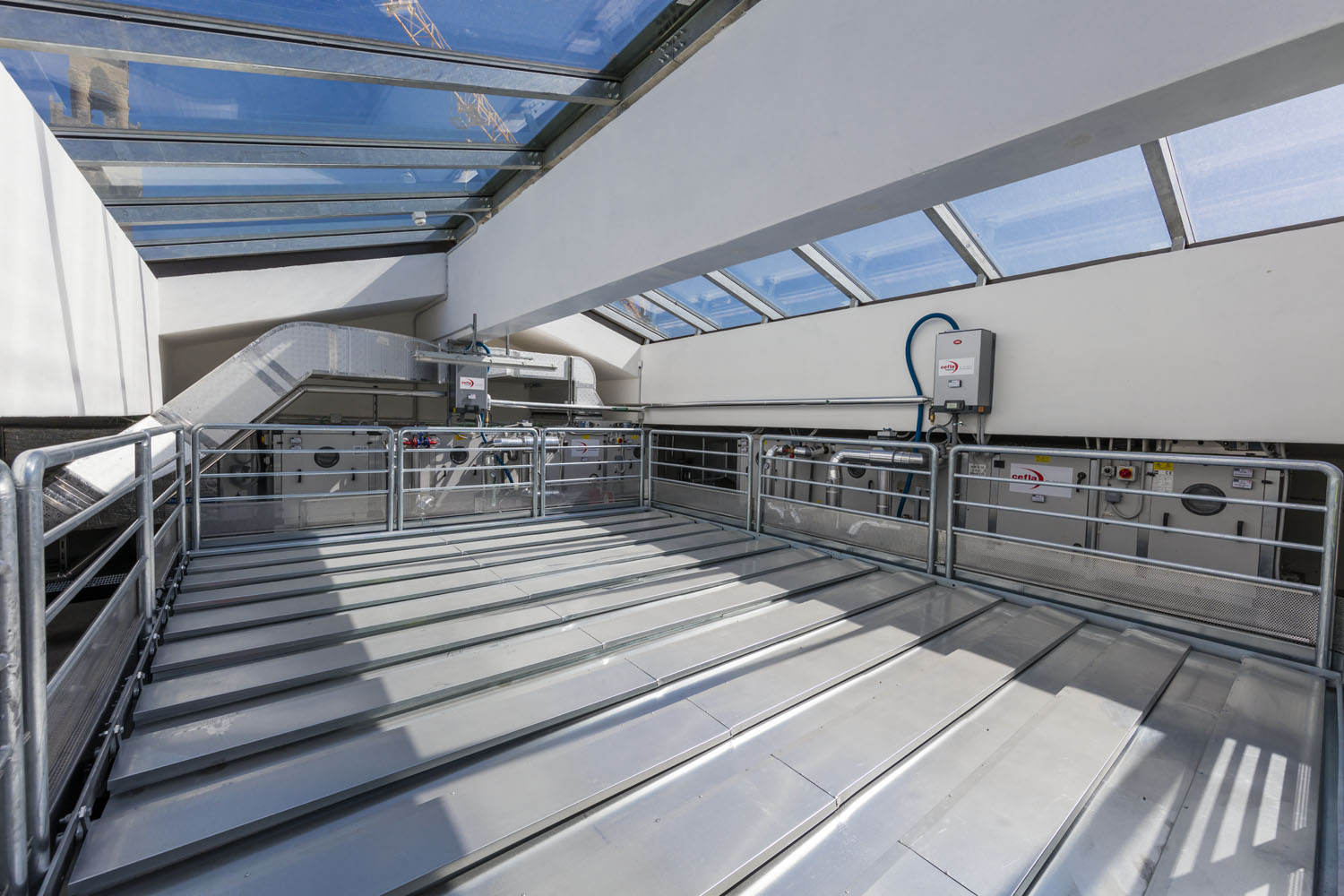


When discussing building service systems, there is a risk of viewing them merely as a technical component of a building or industrial project. In reality, even in less complex contexts, they are much more than that: they are the infrastructure that makes the actual operation of a building, a factory, a museum, a data centre or corporate headquarters possible.
It is these systems that determine operational continuity, safety, comfort, energy efficiency and the ability to adapt over time. That is why today a successful system engineering project is not measured solely by the quality of individual systems, but also by the ability to integrate different features, anticipate problems, reduce interference and deliver a result consistent with the client’s objectives.
In Italy, this topic is particularly relevant because the country’s building and infrastructure stock often requires working under very diverse conditions: new high-efficiency buildings, complex industrial settings, critical infrastructure, historic buildings requiring preservation, and large office or logistics spaces. Each scenario calls for specific solutions, but the best projects almost always share certain elements: integrated planning, a focus on performance, the intelligent use of technology and the ability to consider the entire lifecycle of the project.
In this article, we’ll explore the key trends transforming the world of building systems, the lessons that emerge from successful projects in Italy, and why innovation in building systems is now a tangible driver of competitiveness, sustainability and value.
Innovation and Trends in the World of Building Service Systems
In recent years, the sector of building systems has evolved from a collection of relatively independent subsectors toward a systems-based approach. The most evident change concerns the integration of electrical, mechanical and specialized systems, which are increasingly viewed as parts of a single technological ecosystem.
A key trend is digitalization. Today, a system is no longer merely something that provides energy, climate control, security or monitoring—it is also a source of data. This means continuous monitoring, greater performance visibility, and the ability to make faster, more informed decisions.
A second trend is predictive maintenance, made possible by the convergence of sensors, analytics and digital platforms. In the most advanced settings, the goal is to no longer take action merely when a fault occurs, but to detect alerts and prevent failures, inefficiencies or performance degradation.
A third trend is the growing use of IoT, automation and remote control. In large buildings and technology-intensive infrastructure, coordination between systems has become critical. Building Management Systems, advanced dashboards and shared information models improve overall facility management and help manage energy consumption, comfort, safety and operational continuity.
Added to these factors is an increasingly central issue: sustainability. Today, building systems must do more than just function well. They must help reduce environmental impact, support more ambitious energy goals and make buildings more efficient and resilient over time.
Examples of Successful Building Systems in Italy
Looking at some real-world projects helps us better understand what distinguishes an ordinary system installation from a truly successful one. Even across different sectors, these success stories share certain common elements: strong project coordination, integrated management of activities, a focus on final performance and the ability to adapt technology to specific contexts.
Unipol Tower: Building System Integration in an Iconic Office Building
A prime example is the Unipol Tower in Milan. In this case, the project’s value lies in its ability to tackle a complex and iconic building with an integrated EPC approach, which encompassed the design, construction and commissioning of the building service systems. Coordination via a Building Management System enabled advanced system management, with the goal of optimizing energy consumption and comfort.
This project clearly illustrates a key principle: in highly complex office buildings, the quality of the systems depends on their ability to operate in an integrated manner and in harmony with the building’s architectural and performance identity. When this happens, the systems become a driver of efficiency rather than merely a technical requirement. The numbers also help illustrate the scale of the project: a 130-metre-tall tower, 24 floors, 3,000 kW installed electrical power and 100 kWp photovoltaic capacity.
Uffizi Galleries: Advanced Technology in a Historical and Artistic Context
A second very interesting case is that of the Uffizi Galleries in Florence. Here, the challenge was entirely different: it was a matter of not merely updating a building service system, but of carrying out work in a site of immense historical and heritage value, with the need to combine efficiency, respect for the context and environmental quality for both visitors and the artworks.
The project involved the retrofitting of the entire museum complex, including plumbing, heating and sanitation systems; air conditioning; electrical systems; and control systems. The most interesting aspect is not only the scope of the project but also the guiding principle: integrating technology without impacting the architectural and cultural value of the site. It is precisely in cases like this that one realizes how much building service engineering is about balance as well as performance.
Poste Italiane: Absolute Continuity and Reliability for the Data Center
The Poste Italiane data center project at its Rome EUR headquarters, on the other hand, is an outstanding example of system engineering ensuring operational continuity. In a data center, failure is not measured solely in terms of inefficiency: it is measured in terms of outages, operational risk and loss of service reliability.
The new data center was designed to meet Tier IV certification standards as defined by the Uptime Institute. Among the project’s distinctive features is the use of rotating UPS systems with integrated diesel generators, chosen to ensure absolute operational continuity even in the event of outages, including very brief ones. In this case, the technological systems become the true backbone of a critical infrastructure. The key figures help illustrate the scale of the project: 6,000 kVAR of installed electrical power, 3,200 kW of installed cooling capacity and a project area of 5,500 square metres.
TeaPak: Speed, Coordination and Advanced Systems in the Manufacturing Sector
A fourth useful example comes from the company TeaPak in Imola. Here, the project clearly demonstrates how an integrated approach can have a tangible impact even in the manufacturing sector, where timelines, coordination and the functionality of spaces must be perfectly aligned.
The project was managed by Cefla as a general contractor and encompassed the entire process from design to completion, coordinating all construction and systems installation phases. The project was completed within a particularly tight timeline, despite the pandemic, with the production facility delivered in April 2020 and the office building in May 2020. Once again, a recurring element of all successful projects emerges: mechanical and electrical systems are not treated as a separate project phase, but as an integral part of creating the final value. The site covers a total area of 57,000 m², of which 10,000 m² for the production facility and 1,300 m² for the office building.
Cefla’s experience as a benchmark
When viewed as a whole, these examples reveal a very clear pattern: the most successful plant engineering projects are those managed with an integrated approach, from the feasibility phase through to commissioning. This is precisely the direction of Cefla’s EPC approach, which combines design, procurement, construction and testing for complex technological systems, with the option to extend the scope to general contracting as well.
This approach becomes particularly important when a project involves multiple activities, architectural constraints or demanding performance requirements. In such cases, what makes a difference is not just technical expertise regarding individual systems, but the ability to coordinate each project as a whole: construction work, technological systems, commissioning, interfacing between suppliers and the quality of the end result.
This is also why the experience gained in a wide range of sectors—corporate, historic-artistic, industrial, data centers and healthcare—becomes a valuable design asset. Each sector presents specific challenges, but all require the same added value: effective leadership capable of transforming complexity into a functional, efficient and sustainable system.
Technological systems as a strategic lever for competitiveness
Viewing building systems as mere supporting infrastructure is no longer sufficient today. In the most advanced projects, they become a lever that directly impacts the quality of the building, business continuity, the containment of operating costs and the ability to achieve increasingly challenging energy and environmental goals.
This is why innovation in building systems is not just about technology, strictly speaking. It’s about the method. It’s about the ability to design in an integrated manner, execute each project with precision, monitor performance and build solutions that are consistently effective over time.
In a market that demands smarter buildings, more efficient production sites and more resilient infrastructure, building systems are one of the factors that contribute most tangibly to competitiveness. And the most successful projects in Italy clearly demonstrate this: when building systems are conceived as part of the overall strategy, the value generated extends far beyond the technical scope of the construction site.
Published on July 20, 2026